| Species | Thickness | Width (in) | Length | Qty | Board ft | $ / bf · Cost |
|---|
Thickness under 1 inch is billed as 1 inch, the way a hardwood dealer does it. Prices are typical U.S. retail per board foot and vary by region, grade and width. Type your own price in any row to override it.
That was the lumber bill. Now build the piece.
BuildersJig is a 3D wood shop in your browser. Pull these same boards from the rack, mill them, cut them, join them, and walk out with dimensioned blueprints, a cut list and the cost, with kerf and waste tracked for you. Free plan, no credit card.
▶ Watch the basics · 2 minutes Start free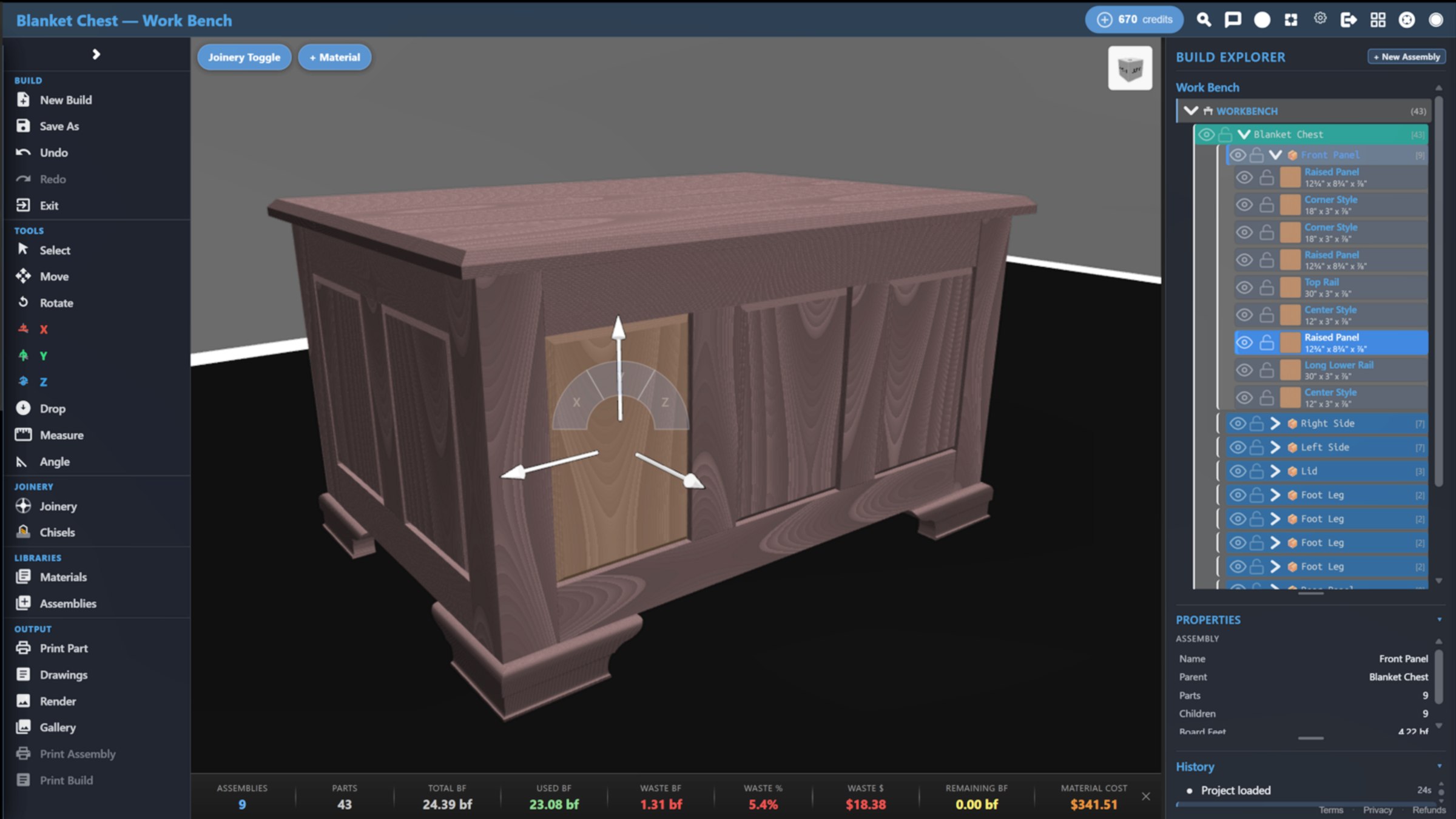
How to calculate board feet
A board foot is a volume: 144 cubic inches, the same as a board 1 inch thick, 12 inches wide and 12 inches long. Hardwood is sold this way because rough boards come in random widths and lengths, so a price per piece would mean nothing.
If you measured the length in inches, divide by 144 instead of 12. Multiply by the number of identical boards.
Worked example
Six shelf boards, each 4/4 (1 inch) thick, 7.5 inches wide and 36 inches long: 1 × 7.5 × 36 ÷ 144 = 1.875 board feet each, 11.25 board feet for all six. In red oak at $6.10 per board foot that is $68.63. With a 20 percent waste allowance, buy 13.5 board feet and budget $82.35.
Quarter thickness chart
Hardwood thickness is quoted in quarters of an inch, measured rough. You pay for the rough size. After flattening and planing, expect to lose about 3/16 inch.
| Called | Rough thickness | Typical finished | Common use |
|---|---|---|---|
| 4/4 | 1" | 13/16" | Cabinet parts, shelves, face frames, drawer fronts |
| 5/4 | 1-1/4" | 1-1/16" | Table tops, stair treads, thicker shelves |
| 6/4 | 1-1/2" | 1-5/16" | Chair parts, bed rails, bench tops |
| 8/4 | 2" | 1-3/4" | Table legs, workbench tops, thick slabs |
| 12/4 | 3" | 2-3/4" | Turning blanks, heavy legs, mantels |
Lumber prices per board foot
These are the prices this calculator uses, from the same library the BuildersJig app prices your builds with. Last reviewed September 2026. Janka hardness is the force in pounds needed to embed a steel ball halfway into the wood. Higher is harder.
| Species | Type | Price / board foot | Janka hardness |
|---|---|---|---|
| African Mahogany | Exotic | $10.20 | 830 lbf |
| Afromosia | Exotic | $19.00 | 1,450 lbf |
| American Beech | Hardwood | $5.95 | 1,300 lbf |
| American Elm | Hardwood | $4.00 | 830 lbf |
| Bald Cypress | Softwood | $6.25 | 510 lbf |
| Basswood | Hardwood | $4.75 | 410 lbf |
| Black Cherry | Hardwood | $6.75 | 950 lbf |
| Black Walnut | Hardwood | $14.25 | 1,010 lbf |
| Bloodwood | Exotic | $18.70 | 2,900 lbf |
| Bocote | Exotic | $28.00 | 2,010 lbf |
| Bubinga | Exotic | $18.00 | 1,980 lbf |
| Butternut | Hardwood | $9.35 | 490 lbf |
| Cherry | Hardwood | $6.75 | — |
| Cocobolo | Exotic | $82.00 | 2,960 lbf |
| Douglas Fir | Softwood | $4.50 | 660 lbf |
| Eastern White Pine | Softwood | $4.50 | 380 lbf |
| Ebony (Gaboon) | Exotic | $170.00 | 3,080 lbf |
| Hard Maple | Hardwood | $7.00 | 1,450 lbf |
| Hickory | Hardwood | $6.00 | 1,820 lbf |
| Indian Rosewood | Exotic | $45.00 | 2,440 lbf |
| Ipe | Exotic | $11.50 | 3,510 lbf |
| Jarrah | Exotic | $9.00 | 1,910 lbf |
| Jatoba | Exotic | $11.60 | 2,350 lbf |
| Kingwood | Exotic | $100.00 | 3,340 lbf |
| Koa | Exotic | $60.00 | 1,170 lbf |
| Leopardwood | Exotic | $20.75 | 1,830 lbf |
| Lignum Vitae | Exotic | $100.00 | 4,500 lbf |
| Merbau | Exotic | $7.00 | 1,925 lbf |
| Padauk | Exotic | $13.75 | 1,725 lbf |
| Pecan | Hardwood | $4.50 | 1,820 lbf |
| Pine | Softwood | $4.50 | — |
| Pink Ivory | Exotic | $90.00 | 3,230 lbf |
| Ponderosa Pine | Softwood | $4.50 | 460 lbf |
| Poplar | Hardwood | $4.20 | 540 lbf |
| Purpleheart | Exotic | $13.00 | 2,520 lbf |
| Red Alder | Hardwood | $3.75 | 590 lbf |
| Red Oak | Hardwood | $6.10 | 1,290 lbf |
| Redwood | Softwood | $7.25 | 420 lbf |
| Sapele | Exotic | $9.10 | 1,410 lbf |
| Sitka Spruce | Softwood | $7.25 | 510 lbf |
| Soft Maple | Hardwood | $6.00 | 950 lbf |
| Southern Yellow Pine | Softwood | $4.00 | 690 lbf |
| Spanish Cedar | Hardwood | $12.00 | 600 lbf |
| Sycamore | Hardwood | $4.75 | 770 lbf |
| Teak | Exotic | $25.00 | 1,000 lbf |
| Wenge | Exotic | $19.00 | 1,930 lbf |
| Western Red Cedar | Softwood | $6.25 | 350 lbf |
| White Ash | Hardwood | $4.50 | 1,320 lbf |
| White Oak | Hardwood | $8.95 | 1,360 lbf |
| Yellow Birch | Hardwood | $4.95 | 1,260 lbf |
| Yellowheart | Exotic | $19.00 | 1,655 lbf |
| Zebrawood | Exotic | $25.00 | 1,575 lbf |
| Ziricote | Exotic | $45.05 | 2,020 lbf |
How much waste should you allow?
Nobody gets 100 percent yield from rough lumber. The saw kerf takes 1/8 inch per cut, board ends are checked, planers snipe, and defects land exactly where you wanted a part. Use 15 to 20 percent for clear, straight stock, and 25 to 30 percent when you need to match grain or colour, or work around knots and sapwood. The most reliable way to know is to lay the parts out on the actual boards. That is what BuildersJig does: every cut is made on a real board in the 3D shop, and the offcuts and waste are counted for you.
Board foot questions
What is a board foot?
A board foot is a unit of volume for lumber: 144 cubic inches. Picture a board 1 inch thick, 12 inches wide and 12 inches long. Hardwood dealers price by the board foot because rough boards come in random widths and lengths.
What is the board foot formula?
Board feet = thickness (inches) × width (inches) × length (feet) ÷ 12. If the length is in inches, divide by 144 instead. Multiply by the number of boards for the total.
What does 4/4, 5/4, 6/4 or 8/4 mean?
Hardwood thickness is quoted in quarters of an inch, measured rough. 4/4 is 1 inch, 5/4 is 1.25 inches, 6/4 is 1.5 inches, 8/4 is 2 inches. You pay for the rough thickness even though the board finishes thinner after planing: 4/4 usually finishes at about 13/16 inch.
Do I use nominal or actual dimensions?
For hardwood sold by the board foot, use the rough (nominal) thickness, with any thickness under 1 inch counted as 1 inch, and the actual measured width and length. Construction lumber such as a 2x4 is sold by the piece or the linear foot, not the board foot.
How much extra lumber should I buy for waste?
Plan on 15 to 20 percent extra for clear, straight stock and 25 to 30 percent for boards with knots, sapwood or figure you need to match. Saw kerf, end checks, snipe and defects all take their share.
How do I convert board feet to cost?
Multiply total board feet by the price per board foot. For example, 12.5 board feet of walnut at $14.25 per board foot is $178.13 before tax and waste.